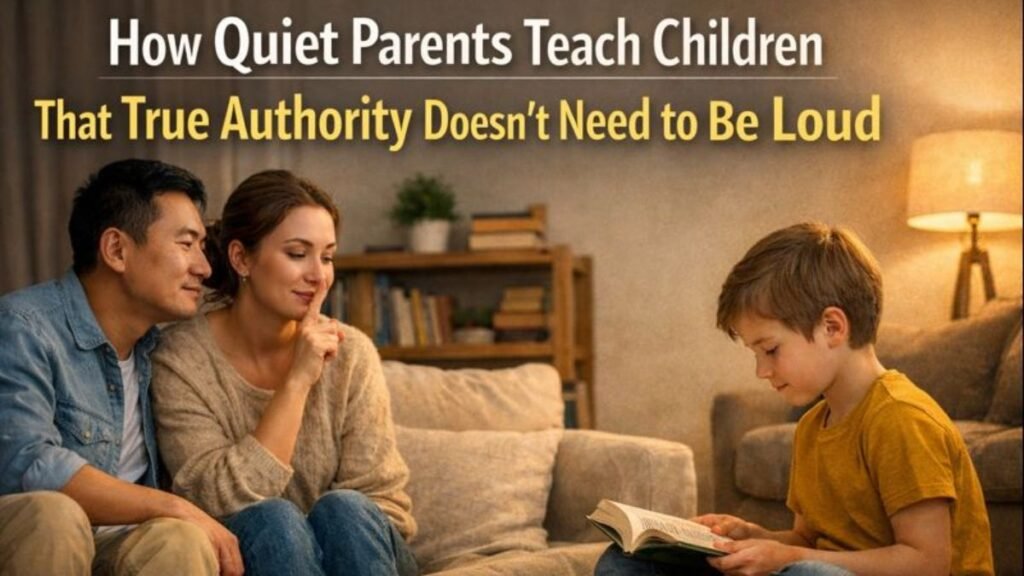

We often assume that authority implies a loud voice, strictness, and control. However, there are homes where parents never raise their voices, yet their presence is felt throughout the entire room. Without shouting or instilling fear, they leave an impression that settles deep within their children’s minds. Teach Children raised in such an environment perceive authority in a completely different light—they learn that true power never needs to prove itself.
The True Strength of Quiet Parenting
Quiet parents teach through their behavior, not merely through words. They do not resort to anger or fear; instead, they guide their children through stability, patience, and self-assurance. When a parent is able to command compliance without raising their voice, children begin to understand that authority is not a function of vocal volume but rather of the depth of one’s character.
Such parents maintain clear boundaries, yet they do not need to shout to enforce them. It is their calm and composed demeanor that reinforces their authority.
Its Profound Impact on Children
When children grow up in such an environment, they learn to behave out of respect rather than fear. They come to realize that rules are to be followed because they are inherently right, not because someone is intimidating them.
This fosters the development of self-discipline within them. Instead of relying on external control, they begin to make decisions based on their own inner understanding. This is precisely why such children often tend to be more self-confident and well-balanced.
A New Perspective on Authority
Quiet parents teach their children that true authority never attempts to prove itself. It requires no shouting or fanfare to demonstrate its strength. It is inherently so robust that its mere presence suffices.
Children internalize this lesson and apply it to their own lives. They come to understand that leadership is not about dominating others, but rather about guiding them in the right direction. They also learn that respect is earned, not imposed.
A Relationship Built on Trust, Not Fear
Where shouting and strictness prevail, fear often takes root. However, where peace and understanding exist, trust is cultivated. Calm parents forge a relationship with their children characterized by openness and honesty.
Children are able to express themselves without fear, acknowledge their mistakes, and learn from them. This relationship fosters their emotional resilience.
How It Helps Later in Life
Children raised in such an environment carry this very principle into their adult lives. In the workplace, in their relationships, and within society, they are able to assert themselves effectively without resorting to loudness. Their self-confidence radiates not from the volume of their voice, but from the strength of their character.
They come to understand that true power is not something to be displayed, but rather something to be felt from within. It is this very insight that shapes them into better human beings and strong leaders.
Conclusion
Calm parents impart an invaluable lesson to their children: that true authority never requires a raised voice. It possesses an inherent strength that allows it to convey everything without uttering a single word.
When children grow up in such an environment, they learn not merely to follow rules, but also to cultivate a deep and balanced perspective on life. It is this very perspective that ultimately shapes them into sensible, self-reliant, and respected individuals.
FAQs
Q1. Do quiet parents have less authority over their children?
A. No, quiet parents often have strong authority because they lead with consistency, calmness, and respect.
Q2. How do children learn from calm parenting?
A. They learn that respect and discipline come from understanding and trust, not fear or loud behavior.
Q3. Why is quiet authority effective in parenting?
A. Because it builds trust, emotional security, and teaches children that real power doesn’t need to be loud.