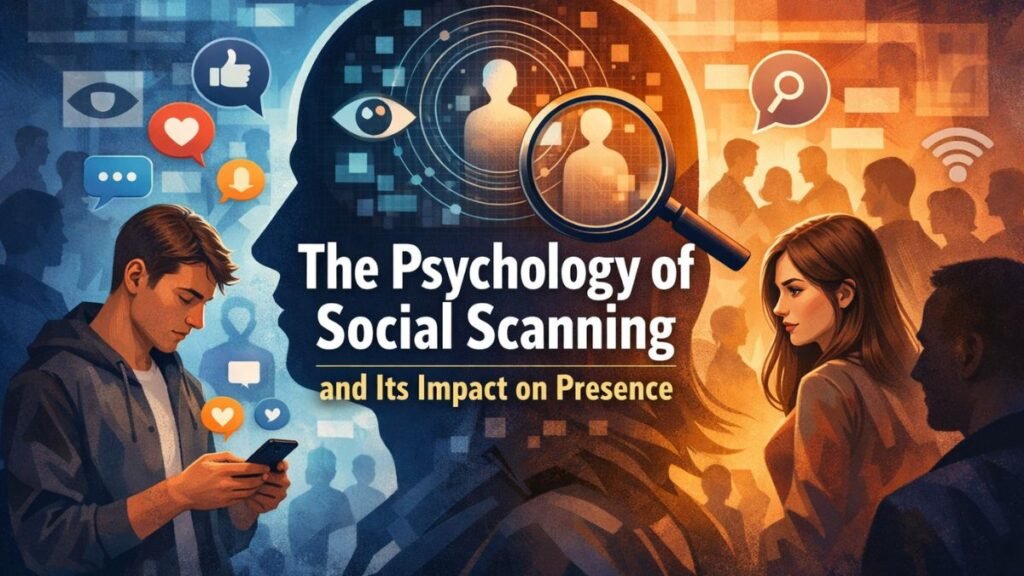

There are many people who, in any given setting, can instantly grasp what others are thinking, what their mood is like, and how best to conduct themselves. In everyday parlance, we refer to this as “reading the room” or interpreting social cues. At first glance, this appears to be a tremendous strength—people admire such individuals, regarding them as insightful and sensitive. However, according to psychology, this very ability can often evolve into a hidden vulnerability. The habit of constantly analyzing others prevents an individual from truly living in the present moment.
What is Social Scanning?
Social scanning entails constantly and closely observing and analyzing the expressions, tone of voice, body language, and behavior of the people around you. It acts as a kind of mental “radar” that picks up on every minute detail. During a conversation, such individuals might notice even the faintest smile or the slightest movement of an eyebrow on the other person’s face.
This habit often develops during childhood or as a result of life experiences—for instance, among those raised in environments where they were compelled to adapt their own behavior to suit the moods of others. Gradually, this skill becomes an integral part of their identity; yet, it comes accompanied by a significant psychological burden.
Why Does This Habit Seem Beneficial?
Individuals who engage in social scanning are often perceived as socially successful. They communicate more effectively, possess a deep understanding of others’ emotions, and are adept at navigating interpersonal relationships. This is precisely why people regard them as “emotionally intelligent.” Such individuals are skilled at avoiding conflicts, knowing exactly what to say and when to say it, and making others feel at ease. This skill also aids their professional advancement, as they possess a keen understanding of team dynamics.
But What Is the Cost?
Psychology posits that everything comes with a price, and social scanning is no exception. When an individual is perpetually preoccupied with deciphering the behavior of others, their focus inevitably shifts away from themselves.
He begins to wonder, “How do I look?” “What are people thinking about me?” “Did I say the right thing?” —and this very overthinking pulls him away from the present moment. He is not fully present in the conversation; instead, he remains entangled within the confines of his own mind.
The Challenge of Staying Present
For those who constantly “read the room,” being mindful or present becomes incredibly difficult. They are analyzing something at every single moment—the tone of someone’s voice, a specific reaction, or a shift in the atmosphere. The outcome of this situation prevents them from experiencing the present time.
The group of friends who are sitting together should enjoy their humorous conversations instead of watching how people respond to different situations. The result of this situation leads to a situation where they experience extremely intense internal fatigue.
Mental Fatigue and Overload
The mind experiences extreme pressure from social scanning because it requires constant practice. The mind experiences cognitive overload when it reaches its limit because it continues to process information. The brain reaches its maximum exhaustion point when it keeps working to handle information.
People who experience this condition will reach mental exhaustion by day’s end without needing to do any physical work. The state of exhaustion will develop into symptoms of anxiety and stress over an extended period.
Drifting Away from Oneself
Social scanning creates its most severe problem when people start forgetting their own emotional states. The person becomes so focused on understanding other people’s feelings that they lose contact with their own emotions. They begin to lose their understanding of who they are as a person. The person adapts their personality to fulfill other people’s wishes, resulting in their true self becoming invisible to others.
Is There a Solution?
The good news is that this habit can be brought into balance. The first step is to recognize that it is not necessary to “read the room” at every single moment. Granting yourself the permission to simply say, “I can just live in this moment,” is a crucial step forward.
Mindfulness practices—such as deep breathing, observing one’s surroundings without judgment, and simply noticing one’s thoughts—all serve to anchor an individual back in the present moment. Furthermore, connecting with oneself—specifically by understanding one’s emotions and recognizing one’s needs—is equally vital.
Striking a Balance is Key
Social scanning is not inherently wrong. It is, in fact, a valuable skill; however, it becomes problematic when taken to excess. True wisdom lies in discerning when to employ this skill and when to simply relax and live fully in the present moment. Once an individual masters this balance, they not only gain a deeper understanding of others but also cultivate a profound connection with themselves.
Conclusion
Social scanning connects us to others, yet if this habit spirals out of control, it can alienate us from ourselves. Psychology teaches us that true happiness and peace are attained only when we are fully present in the current moment. Therefore, it is essential that we strive to understand ourselves just as we strive to understand others—for ultimately, the most significant relationship we have is the one we share with ourselves.
FAQs
Q1. What is social scanning in psychology?
A. Social scanning is the habit of constantly observing and analyzing others’ emotions, behaviors, and reactions in social situations.
Q2. Why do people who read the room struggle to stay present?
A. Because their mind is focused on analyzing others instead of experiencing the current moment, leading to distraction.
Q3. Is social scanning a good or bad habit?
A. It can be both—helpful for understanding people, but harmful if it causes overthinking and loss of presence.