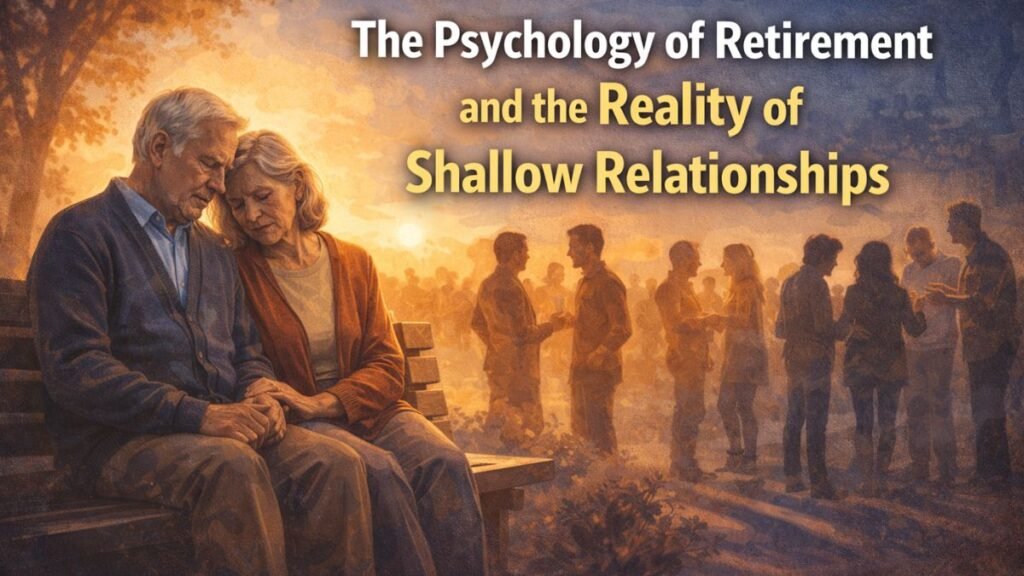

People generally view retirement as a comfortable phase of life—a time when an individual is liberated from responsibilities and lives in peace. However, from a psychological perspective, this period can also prove to be emotionally very challenging for many. This is particularly true when individuals realize that the relationships they relied upon for years were not as deep as they had imagined. Consequently, retirement is not merely a departure from work; it also forces one to confront the unvarnished truth about one’s relationships.
What Was the True Foundation of These Relationships?
In professional life, most relationships are forged through daily interactions, working side-by-side, and sharing a common environment. Offices, colleagues, neighbors, or routine encounters—all play a significant role in keeping these relationships alive. However, once retirement brings an end to this “proximity”—this physical closeness—many relationships begin to gradually wither away.It is at this juncture that an individual realizes that many of their relationships were not, in fact, grounded in emotional depth, but rather in convenience and habit.
The Reality of Shallow Relationships
In psychology, these are referred to as “shallow relationships”—connections that exist only at a superficial level. While they involve conversation and shared time, they often lack deep emotional understanding or genuine curiosity about the other person.
Once retirement puts an end to daily encounters and interactions, such relationships tend to slowly fade away.This experience can leave an individual feeling profoundly lonely on the inside, even if they are not physically alone.
What Constitutes True Loneliness?
Interestingly, the true loneliness experienced in retirement does not stem merely from being physically alone, but rather from the realization that people were part of your life simply because circumstances dictated it—not because they genuinely desired to know you as a person.This can be a profound emotional shock, as the individual had believed their relationships were robust, only to discover that they were, in reality, sustained solely by the passage of time and the force of circumstance.
Habit and Convenience vs. Genuine Connection
Many relationships endure simply because they have become an integral part of our daily routine. Such as colleagues one meets daily, or people with whom one interacts regularly. However, when this routine is disrupted, the true strength of these relationships is revealed.True relationships are those that endure despite distance and the passage of time, whereas fragile relationships survive solely out of convenience and habit.
Emotional Shifts After Retirement
Retirement marks a significant transition in an individual’s life. Time suddenly becomes abundant, while social interactions diminish. Amidst this void, the individual begins to reflect more deeply upon their past.This is the juncture at which many people re-evaluate their relationships, coming to realize who was truly connected to them and who was merely a circumstantial presence.
Is This Entirely a Negative Experience?
Although this experience can be somewhat emotionally challenging, it also possesses a positive dimension. It offers the individual an opportunity to grasp the true nature of their relationships.Through this process, people can learn that, moving forward, they should prioritize relationships founded not merely on convenience, but on genuine emotional connection.
How Can Deep Relationships Be Cultivated?
Psychology suggests that building deep relationships requires not only time but also genuine interest and emotional investment.Taking a sincere interest in people’s lives—their feelings, thoughts, and experiences—serves to strengthen the bonds of a relationship.
If relationships remain confined solely to the realms of work, convenience, or daily routine, they will not endure in the long run.
Conclusion: Identifying True Relationships Is a Profound Life Lesson
“The Psychology of Retirement and the Reality of Shallow Relationships” teaches us that retirement is not merely a departure from work; it is also a time to confront the reality of our relationships.
While this experience may occasionally bring moments of loneliness, it grants us the opportunity to understand that true relationships are those that remain steadfast by our side—without any compulsion and without the need for convenience. Ultimately, it is this very realization that guides us toward forging more authentic and profound connections.
FAQs
Q1. Why do relationships feel different after retirement?
A. Because many relationships were based on daily routine, proximity, and shared environments rather than deep emotional bonds.
Q2. What does psychology say about shallow relationships in retirement?
A. Psychology suggests that retirement reveals which relationships lacked true emotional depth and were maintained by habit.
Q3. Does retirement always lead to loneliness?
A. No, but it can create emotional reflection that may feel like loneliness when routine-based connections fade.