
In today’s fast-evolving academic world, research is no longer confined to isolated labs or locked behind paywalls. The concept of open science has transformed how knowledge is created, shared, and validated. It promotes transparency, accessibility, and collaboration, allowing researchers from different parts of the world to contribute to a collective pool of knowledge. As this movement continues to grow, a wide range of tools has emerged to support researchers in making their work more open, efficient, and impactful.
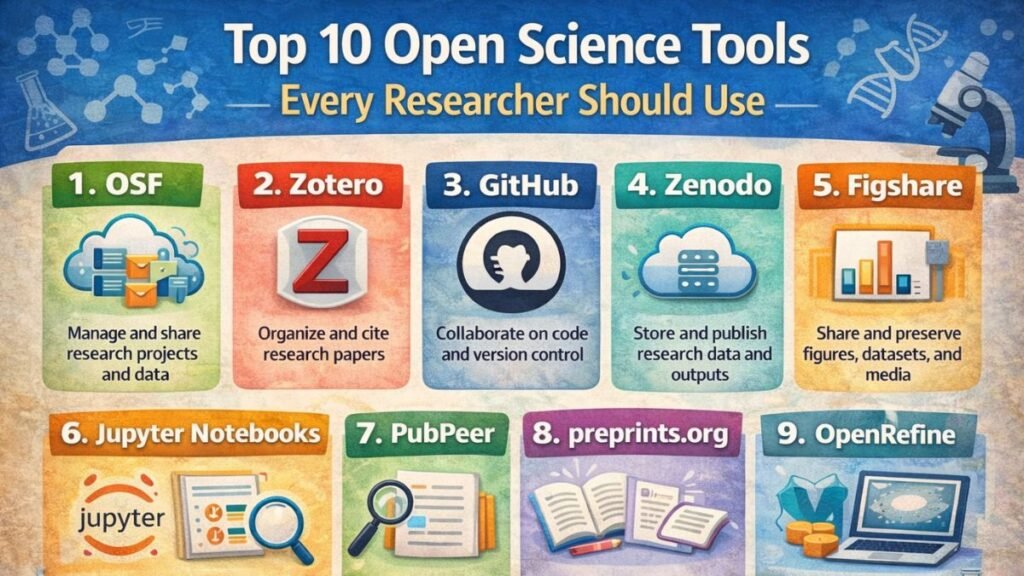
Open science tools are not just optional add-ons; they are becoming essential components of modern research workflows. Whether you are a student, an early-career researcher, or an experienced academic, using the right tools can significantly enhance your productivity and the visibility of your work. In this article, we explore the top 10 open science tools that every researcher should consider integrating into their daily workflow.
The Rise of Open Science in Modern Research
The traditional model of research often involved restricted access to data, limited collaboration, and slow dissemination of results. Open science challenges this model by encouraging researchers to share their data, methodologies, and findings openly. This approach not only accelerates scientific discovery but also improves reproducibility and trust in research outcomes.
With the increasing demand for transparency and accountability, funding agencies and academic institutions are also promoting open science practices. As a result, researchers are turning to specialized tools that facilitate open access publishing, data sharing, collaboration, and version control. These tools are designed to simplify complex processes and ensure that research remains accessible to a broader audience.
Enhancing Collaboration Through Digital Platforms
Collaboration lies at the heart of open science, and digital platforms have made it easier than ever for researchers to work together across geographical boundaries. Tools like Overleaf allow multiple authors to write and edit research papers in real time, making the process seamless and efficient. This is particularly useful for teams working on complex documents that require precise formatting.
Similarly, platforms such as GitHub have become indispensable for researchers who work with code. By enabling version control and collaborative coding, GitHub ensures that every change is tracked and documented. This not only enhances transparency but also makes it easier for others to replicate and build upon existing research.
These tools are redefining how researchers interact, making collaboration more dynamic and inclusive than ever before.
Open Data Sharing and Management
Data is the backbone of any research project, and managing it effectively is crucial. Open science tools have made it possible to store, organize, and share datasets in a way that is both secure and accessible. Zenodo is one such platform that allows researchers to upload their datasets, assign a digital object identifier (DOI), and make their work publicly available.
Another powerful tool is Figshare, which supports a wide range of file types and enables researchers to share their findings with a global audience. By making data openly available, these platforms encourage reuse and validation, ultimately strengthening the credibility of scientific research.
Effective data management not only improves research quality but also ensures compliance with funding requirements and institutional policies.
Streamlining Literature Discovery and Reference Management
Keeping track of existing literature is one of the most challenging aspects of research. Open science tools have simplified this process by offering advanced search capabilities and efficient reference management systems. Zotero is a popular choice among researchers for organizing citations and generating bibliographies with ease.
In addition, platforms like Google Scholar provide quick access to a vast repository of academic papers, theses, and conference proceedings. These tools help researchers stay updated with the latest developments in their field and ensure that their work is grounded in existing knowledge.
By integrating these tools into their workflow, researchers can save time and focus more on analysis and innovation.
Preprints and Open Access Publishing
One of the key principles of open science is making research accessible to everyone. Preprint servers and open access journals play a vital role in achieving this goal. Platforms such as arXiv allow researchers to share their findings before formal peer review, enabling rapid dissemination of knowledge.
Open access publishing ensures that research articles are freely available to readers without subscription barriers. This not only increases the visibility of research but also enhances its impact. By using these platforms, researchers can reach a wider audience and contribute to a more inclusive scientific community.
The shift toward open access is transforming the publishing landscape, making it more equitable and transparent.
Improving Reproducibility and Transparency
Reproducibility is a cornerstone of scientific research, yet it has often been a challenge due to lack of access to data and methodologies. Open science tools address this issue by providing platforms for sharing complete research workflows. Open Science Framework is designed specifically to support transparency and reproducibility.
This platform allows researchers to document every stage of their project, from data collection to analysis and publication. By making this information publicly available, it becomes easier for others to verify results and build upon existing work.
Transparency not only strengthens the integrity of research but also fosters trust within the scientific community.
Data Analysis and Computational Tools
Modern research often involves complex data analysis, and open science tools have made advanced computational resources more accessible. Programming languages and platforms like R and Jupyter Notebook enable researchers to perform sophisticated analyses and visualize data effectively.
These tools are particularly valuable for reproducible research, as they allow users to share both code and results in a single document. This makes it easier for others to understand and replicate the analysis, ensuring that findings are reliable and transparent.
By adopting these tools, researchers can enhance the quality and efficiency of their work.
Building Academic Profiles and Increasing Visibility
In the digital age, having a strong academic presence is essential for researchers. Open science tools have made it easier to showcase research outputs and connect with peers. Platforms like ORCID provide unique identifiers that help distinguish researchers and link their work across different platforms.
Similarly, ResearchGate allows researchers to share publications, ask questions, and collaborate with others in their field. These platforms not only increase visibility but also create opportunities for networking and collaboration.
By maintaining an active online presence, researchers can enhance their professional reputation and expand their reach.
The Role of Open Science Tools in Future Research
As technology continues to advance, the role of open science tools is expected to grow even further. Artificial intelligence, machine learning, and cloud computing are likely to be integrated into these platforms, making research more efficient and accessible.
The future of research will be defined by openness, collaboration, and innovation. Open science tools will play a crucial role in shaping this future by breaking down barriers and enabling researchers to work together more effectively.
Adopting these tools today is not just about staying current—it is about preparing for the future of science.
Conclusion
Open science is more than just a trend; it is a fundamental shift in how research is conducted and shared. The tools discussed in this article represent some of the best resources available to researchers who want to embrace this new approach.
By integrating open science tools into their workflow, researchers can improve collaboration, enhance transparency, and increase the impact of their work. These tools empower individuals to contribute to a global knowledge ecosystem, where information is freely accessible and continuously evolving.
In a world where knowledge is power, open science tools ensure that this power is shared, not restricted. For researchers at every stage of their career, adopting these tools is a step toward a more connected, transparent, and innovative future.