
Publishing a research paper for the first time can feel both exciting and overwhelming. For many beginners, the process seems complex, filled with unfamiliar terms like peer review, journal indexing, and manuscript formatting. However, once you understand the steps involved, the journey becomes far more manageable.
A research paper is not just a requirement for academic success; it is a way to share your ideas, discoveries, and insights with a wider audience. Whether you are a student, a scholar, or an independent researcher, publishing your work allows you to contribute to your field and establish your credibility. This guide walks you through the process step by step, helping you navigate each stage with clarity and confidence.
Understanding the Purpose of a Research Paper
Before diving into the publishing process, it is important to understand what a research paper truly represents. At its core, a research paper is a structured document that presents a question, explores it through evidence, and arrives at a conclusion based on analysis.
It is not just about writing what you know; it is about contributing something new to existing knowledge. Even small insights, when supported by proper research and reasoning, can add value. Recognizing this purpose helps you approach your work with the right mindset, focusing on clarity, originality, and accuracy.
Choosing the Right Research Topic
The foundation of any strong research paper lies in its topic. Selecting a topic that is both interesting and relevant is crucial. Beginners often make the mistake of choosing topics that are too broad or too complex, which can make the research process difficult to manage.
A good topic should be specific enough to allow detailed exploration while still offering enough material for research. It should also align with your interests, as this will keep you motivated throughout the process. When you are genuinely curious about your topic, your writing naturally becomes more engaging and insightful.
Conducting Thorough Research
Once you have a topic, the next step is to gather information. This involves reading books, academic journals, research articles, and credible online sources. The goal is to understand what has already been studied and identify gaps that your research can address.
Taking organized notes during this stage is essential. It helps you keep track of important points, references, and ideas that you may want to include in your paper. At the same time, it is important to evaluate the credibility of your sources to ensure that your research is based on reliable information.
Thorough research not only strengthens your arguments but also builds your confidence as a writer. The more you understand your topic, the easier it becomes to present your ideas clearly.
Structuring Your Research Paper
A well-structured paper is easier to read and understand. Most research papers follow a standard format that includes an introduction, literature review, methodology, results, discussion, and conclusion.
The introduction sets the stage by explaining the research problem and its significance. The literature review provides context by summarizing existing studies. The methodology explains how the research was conducted, while the results present the findings. The discussion interprets those findings, and the conclusion ties everything together.
Maintaining a logical flow between these sections is crucial. Each part should connect smoothly to the next, guiding the reader through your research journey.
Writing the First Draft
Writing your first draft can feel challenging, but it is important to remember that it does not have to be perfect. The goal at this stage is to get your ideas down on paper. Focus on expressing your thoughts clearly rather than worrying about grammar or style.
It is often helpful to start with the sections you feel most comfortable with. Some writers prefer beginning with the methodology or results, while others start with the introduction. There is no single correct approach; what matters is finding a method that works for you.
As you write, keep your audience in mind. Use clear and simple language to explain complex ideas, ensuring that your paper is accessible to readers who may not be experts in your field.
Revising and Editing Your Paper
Once your first draft is complete, the next step is revision. This is where your paper begins to take its final shape. Editing involves checking for clarity, coherence, and accuracy.
Read your paper multiple times, focusing on different aspects each time. Look for areas where your arguments can be strengthened or where additional evidence may be needed. Pay attention to the flow of your writing, ensuring that each paragraph connects logically to the next.
Grammar, punctuation, and formatting should also be carefully reviewed. Even small errors can affect the credibility of your work, so it is important to polish your paper thoroughly.
Selecting the Right Journal
Choosing the right journal is a critical step in the publishing process. Not all journals are suitable for every type of research, so it is important to find one that aligns with your topic and field of study.
Consider factors such as the journal’s scope, audience, and reputation. Reading previously published articles can give you an idea of whether your paper is a good fit. It is also helpful to review the journal’s submission guidelines, as each publication has its own requirements.
Selecting the right journal increases your chances of acceptance and ensures that your work reaches the right audience.
Understanding the Peer Review Process
One of the most important aspects of academic publishing is the peer review process. After you submit your paper, it is evaluated by experts in your field who assess its quality, originality, and relevance.
Receiving feedback from reviewers can be both challenging and valuable. It is not uncommon for papers to be returned with suggestions for revision. Instead of viewing this as a setback, consider it an opportunity to improve your work.
Responding to reviewer comments thoughtfully and making necessary changes demonstrates your commitment to quality and increases the likelihood of publication.
Submitting Your Research Paper
Once your paper is polished and you have selected a journal, it is time to submit your manuscript. This usually involves uploading your document through the journal’s online submission system and providing additional details such as author information and a cover letter.
The cover letter is your chance to briefly explain the significance of your research and why it is a good fit for the journal. Writing a clear and concise cover letter can create a positive impression on the editors.
After submission, the waiting period begins. This can take several weeks or even months, depending on the journal. Patience is key during this stage.
Dealing with Acceptance or Rejection
The outcome of your submission can vary. If your paper is accepted, it may still require minor revisions before publication. This is a normal part of the process and should be approached with care.
If your paper is rejected, it is important not to be discouraged. Rejection is a common experience in academic publishing, even for experienced researchers. Take the feedback provided, improve your paper, and consider submitting it to another journal.
Persistence and resilience are essential qualities for any researcher. Each submission brings you closer to success.
Building Confidence as a Researcher
Publishing your first research paper is a significant milestone. It not only adds to your academic achievements but also boosts your confidence as a researcher. Over time, the process becomes more familiar, and your skills continue to improve.
Engaging with the academic community, attending conferences, and collaborating with other researchers can further enhance your growth. The more you immerse yourself in the research environment, the more opportunities you will find to contribute and succeed.
Conclusion: From Beginner to Published Author
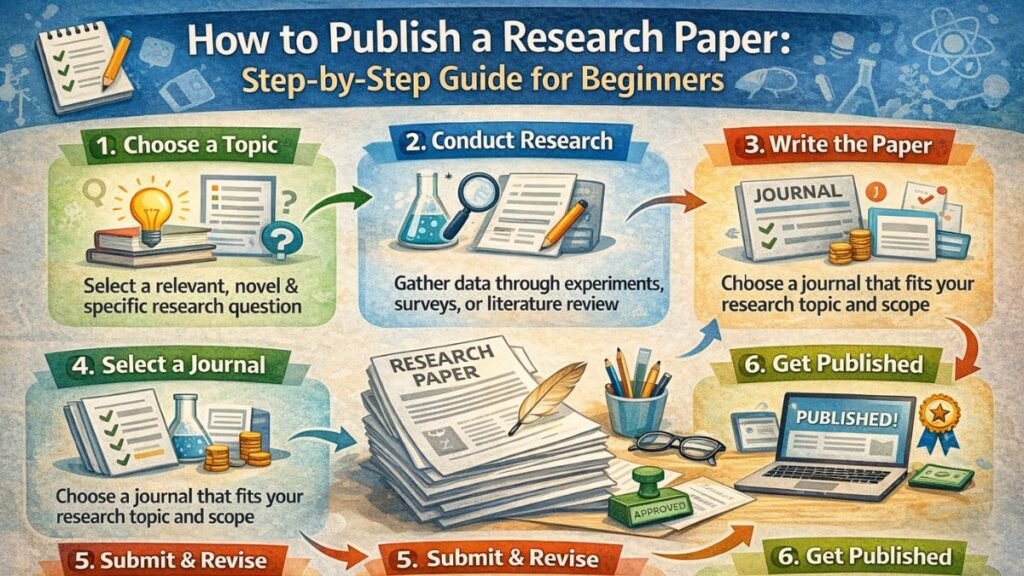
The journey of publishing a research paper may seem complex at first, but it becomes manageable when broken down into clear steps. From choosing a topic and conducting research to writing, revising, and submitting your paper, each stage plays a vital role in the final outcome.
For beginners, the key is to stay patient, persistent, and open to learning. Every researcher starts somewhere, and each experience adds to your knowledge and confidence. By following these steps and maintaining a commitment to quality, you can successfully transform your ideas into a published research paper and make your mark in the academic world.