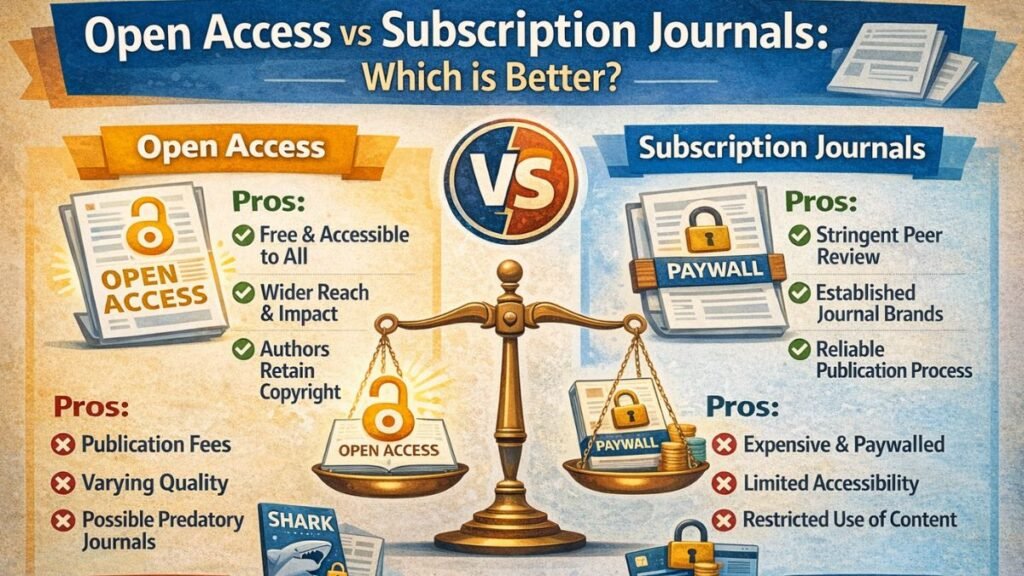

In the evolving world of academic publishing, one debate continues to shape how research is shared and consumed: open access versus subscription journals. For researchers, students, and institutions, choosing between these two models is not just a technical decision—it is a strategic one that influences visibility, accessibility, and even career growth.
Subscription journals represent the traditional model of publishing. In this system, readers or institutions pay to access research articles. Universities often subscribe to multiple journals, allowing their students and faculty to read the latest studies. However, individuals without institutional access may find themselves locked out behind paywalls.
Open access journals, on the other hand, aim to remove these barriers. Research published in open access formats is freely available to anyone with an internet connection. Instead of readers paying for access, the cost is often covered by authors, institutions, or funding agencies.
Understanding these two systems is essential before determining which one is “better,” because the answer depends largely on perspective and priorities.
Accessibility and Reach of Research
One of the most significant differences between open access and subscription journals lies in accessibility. Open access journals make research available to a global audience without restrictions. This means that students in developing countries, independent researchers, and even the general public can read and benefit from the work.
In contrast, subscription journals limit access to those who can afford it or belong to institutions with subscriptions. While this model supports high-quality publishing infrastructure, it creates a gap between those who have access and those who do not.
From a reach perspective, open access clearly has an advantage. When research is freely available, it is more likely to be read, shared, and cited. This increased visibility can benefit authors by amplifying the impact of their work.
However, accessibility is not the only factor to consider. The publishing process, costs, and reputation also play crucial roles.
Cost Considerations for Authors and Readers
The financial structure of these models is fundamentally different. In subscription journals, readers bear the cost through subscriptions or individual article purchases. Authors typically do not pay to publish, which can be appealing, especially for early-career researchers with limited funding.
Open access journals shift this cost to the authors or their institutions. Article processing charges can be significant, sometimes reaching thousands of dollars. While many funding agencies support these costs, not all researchers have access to such resources.
This creates a paradox. Open access removes barriers for readers but can introduce financial challenges for authors. Subscription journals, meanwhile, make publishing easier for authors but restrict access for readers.
The question of which model is better often depends on who is paying and who is benefiting.
Quality, Credibility, and Peer Review
A common misconception is that open access journals are of lower quality than subscription journals. In reality, both models include highly reputable, peer-reviewed publications. Quality depends on the journal itself, not the access model.
That said, the rise of open access has also led to the emergence of predatory journals. These are low-quality publications that charge authors fees without providing proper peer review or editorial standards. This has created skepticism around open access, even though many open access journals maintain rigorous review processes.
Subscription journals, with their long-established reputations, are often perceived as more credible. Many high-impact journals operate under this model, which can influence career advancement and academic recognition.
However, the gap is narrowing. Many prestigious journals now offer open access options, and the academic community is increasingly recognizing the value of openly shared research.
Impact on Research Visibility and Citations
Visibility is a critical factor for researchers. The more people who read and cite a study, the greater its impact. Open access journals tend to perform well in this regard because they remove barriers to access.
When an article is freely available, it can be shared across platforms, referenced in policy documents, and accessed by a wider audience. This often leads to higher citation rates compared to articles locked behind paywalls.
Subscription journals, while prestigious, may limit exposure. Even groundbreaking research can go unnoticed if it is inaccessible to a broader audience.
For researchers who prioritize visibility and influence, open access can be a powerful tool. It ensures that their work reaches not just academics, but also practitioners, policymakers, and the public.
Ethical and Social Considerations
The debate between open access and subscription journals is not just about convenience or cost—it also involves ethical considerations. Many argue that publicly funded research should be freely available to the public. After all, taxpayers often support the research, so they should have access to the results.
Open access aligns with this principle by promoting transparency and inclusivity. It supports the idea that knowledge should be a shared resource, not a restricted commodity.
Subscription journals, while providing valuable services, can sometimes conflict with this ideal. Paywalls can prevent important information from reaching those who need it most, particularly in fields like healthcare or environmental science.
This ethical dimension is one of the driving forces behind the growing movement toward open access publishing.
Flexibility and Publishing Options
The publishing landscape is becoming more flexible, with many journals offering hybrid models. These allow authors to choose whether to publish their work as open access or within a subscription framework.
This flexibility provides a middle ground. Authors can weigh the costs and benefits of each option based on their specific needs, funding availability, and career goals.
For example, a researcher may choose open access for a study with broad societal relevance, ensuring maximum reach. For other work, they might opt for a subscription journal with a strong reputation in their field.
This evolving approach reflects the changing nature of academic publishing, where rigid boundaries are gradually being replaced by more adaptable systems.
Future Trends in Academic Publishing
The future of academic publishing is increasingly leaning toward openness. Governments, funding agencies, and institutions are pushing for policies that require open access to research outputs.
Initiatives supporting open science are gaining momentum, encouraging researchers to share not just their findings but also their data and methodologies. This shift is transforming how knowledge is created and disseminated.
At the same time, subscription journals are adapting. Many are introducing open access options, improving digital access, and exploring new business models to remain relevant.
Technology is also playing a role, making it easier to share, access, and analyze research. As these trends continue, the distinction between open access and subscription models may become less pronounced.
Which Is Better? A Balanced Perspective
So, which is better—open access or subscription journals? The answer is not straightforward. Each model has its strengths and limitations, and the “better” choice depends on individual priorities.
Open access excels in accessibility, visibility, and ethical alignment. It ensures that research reaches a wide audience and contributes to a more inclusive knowledge ecosystem.
Subscription journals offer established credibility, often lower costs for authors, and a long history of academic prestige. They remain an important part of the publishing landscape.
Rather than viewing these models as competitors, it may be more useful to see them as complementary. Together, they provide diverse options that cater to different needs and circumstances.
Final Thoughts on Choosing the Right Model
In the end, the choice between open access and subscription journals is deeply personal and context-dependent. Researchers must consider their goals, resources, and the nature of their work.
What matters most is not just where research is published, but how it contributes to knowledge, innovation, and society. Both models have a role to play in this process.
As the academic world continues to evolve, the focus is shifting toward greater openness, collaboration, and impact. Whether through open access or subscription journals, the ultimate goal remains the same: to advance knowledge and make it meaningful for the world.